Monday, October 29, 2007

Germany’s National Cycling Plan

Germany's National Cycling Plan Germany's national cycling strategy 2002-2012 aims to promote cycling in Germany as part of a sustainable, integrated transport policy. In 2002, the German National Cycling Plan (Nationaler Radverkehrsplan) was adopted by the government.Its aim is to increase bicycle use and road safety considerably by 2012 and to promote healthy and environmentally friendly local mobility in accordance with the concept of the “city of short distances”.The National Cycling Plan is available in English, French, Russian and Spanish. Full text download:
Germany’s National Cycling Plan - Fahrradportal > Aktuell > Neuigkeiten - Fahrradportal Nationaler Radverkehrsplan

Blogged with Flock

Cycling England : Demonstration Towns

Cycling Demonstration Town
Six towns in England are sharing nearly £17 million to promote cycling.The Cycling Demonstration Towns are leading the way in encouraging local people to use pedal power. The funds are being used to make the environment more cyclist friendly, to offer safety training and to encourage take up through extensive promotion.Through the Cycling Demonstration Towns project, Cycling England is funding and working with six local highway authorities to develop an exemplary physical environment for cycling, supported by a comprehensive range of 'soft' measures to encourage more people to cycle. Its purpose is to deliver a step-change in cycling levels, in towns which start from a low or moderate cycling mode share.
Cycling England : Demonstration Towns

Blogged with Flock

Saturday, October 27, 2007

Urban Cycling


DSC00098.jpg


Cycling should be encourage in urban areas. It will help reduce traffic congestions and air pollutions. The cyclist will definitely improve his/her general health as it is a good form of exercise.

Local authority should take the lead in this matter. The photo above is a special cycling lane that I took while visiting my son in London this summer.

Blogged with Flock

Open Sky AFTA 2009

According to sources in the aviation industry, the ASEAN region will adopt an open sky policy by the year 2009. What are the impacts to the industry and the public as a consequence of this policy?

DSC00032.jpg


My guess !!!

  • Price war between airlines. We the consumers will gain on the short term basis
  • The stronger and cash rich airlines  will eventually dominate the market
  • Perhaps the smaller airlines will gang together to form a bigger company
  • The region will see more people travelling, opening grater opportunities
However I am sure with the region opening up, the net economic growth will be positive. Dont forget ASEAN is 520 million population...bigger than USA.

Blogged with Flock

Thursday, June 14, 2007

Bicycle Lane


The photo of a special cyclist lane was taken in London last month. The bicycle lanes may be common in many European cities but are considered rare in South East Asia. Kuala Lumpur the city I am residing do not have this. Bicycle is cheap and pollution free, as such it is common sense to encourage many people to cycle in cities. Perhaps the climate is one major distracting factor. But then why not give it a try.

Shared with Flock - The Social Web Browser
http://www.flock.com

Pedestrianization in Munich....

Posted by Picasa

Wednesday, January 31, 2007

Floods and Logistics

The recent floods in the Southern part of Peninsular Malaysia raise few points with regards to logistics and transportation.

1. Movement of goods for relief purposes is very important. Its about life and death.
2. Cheap, fast and safe movement of supplies to flood victims is the main factor to be considered.
3. Quick evacuation of the children, elderly and disabled is top priority.

As such transportation planning and coordination in such circumstances is very critical. Do we have enough professional to execute the mission?

Friday, September 22, 2006

DOE to videotape smoky vehicles

The article from STAR Newspaper on smokey vehicles is a welcome signs that things are changing. Transport should not contribute to air pollution.

DOE to videotape smoky vehicles

Tuesday, September 12, 2006

I was in Penang recently. Conducting a class on transportation planning for CILT students. We discussed few issues pertaining transportation in relation to the Malaysian Economy. It was quite fortunate that we have with us a copy of the newspaper pull-out section on the economic report presented by the Prime Minister in his 2007 budget presentation in parliament recently.

After a lengthy discussions the class came to the following conclusions:

  • The economy will continue to grow at about 6% per annum for a foreseeable future.
  • The manufacturing sector is also poised to grow, even though at a slightly lower rate.
  • The agriculture sector will be the focus of the government.
  • However we noticed that the service sector failed to produce the expected growth.
  • Malaysia exported more that what it consumed. Therefore the balance of trade is in her favor.

The impact of the above to transportation will be as follows:

  • People will enjoy a favorable economy. Their disposable income will increase. As such we can expect that more people will be able to own cars. Perhaps more than one car per household. This will translate into more traffic congestion. More stresses and higher medical bills.
  • Since the manufacturing sector continues to record a substantial growth, we should expect the migration of people from rural to urban areas will increased as compared to previous years. More urban population. More sprawling of townships. Making travel much more difficult. Thus increasing the cost of travel.
  • The increase in exports and imports of goods will create generate growth of traffic at ports and airports. If the feeder services from factories and warehouses are not improved than the congestion at ports will continue to increase.

To enhanced the transportation due to the favorable economic outlook, the following were suggested:

  • Enhanced the availability of public transportation. Targetting more that 50% of the population to be using public transport in their daily activities. Compared with just 18% today.
  • Increase the roles of rail systems in the movement of goods in and out of ports and airports.
  • Proper urban planning to avoid sprawling. And ensure the urban areas are public transport friendly.
  • ENVIRONMENTAL ISSUES MUST BE GIVEN SERIOUS CONSIDERATION.

We all must strive to make Malaysia a new model of an industrialized country. Where cultural values, modernization and ecosystem are in balanced

Sunday, February 12, 2006

Reduce Road Accidents

In Malaysia for the last three months were very busy period. The are many festivals and holidays. People took advantaged of the situations to visit friends and relatives. The highways were congested. Busy..busy...

Since many are fond of using their own private cars and vans, public transport were not popular. One would only use public transport if there were no other choices. But of course we offer world class excuses for not using it.

But what price are we paying? lives...hundreds died because of accidents during the festive holidays.

Use public transport and surely we can reduce road accidents and prevent unneccesary lost of lives.

I support the government in their campaign !!!

Friday, October 14, 2005

New automobiles but what about public transportation ?

The number of new cars on the road is increasing. In Malaysia, new models are introduced every year by the national car manufacturers and also many more are imported.

This is what the Star newspaper reported recently " Perodua's managing director Hafiz Syed Abu Bakar recently said that sales of MyVi have surpassed expectations: There are already 19,000 MyVis on the road and we expect it to grow to 36,000 units by end of this year." This is only one model... what about other models

I am concerned with such increased in private automobiles, are there enough land in Kuala Lumpur and other big cities to build roads for these new babies. Do we have the fund ?

Sad to see that the development of public transportation is not at the same level of activities with the private cars. Studies have shown that public transportation is much more effective than private cars in urban areas.

We must understand that movement is an important factor in ensuring a better life in this modern world we call HOME.

 Posted by Picasa

Saturday, October 01, 2005

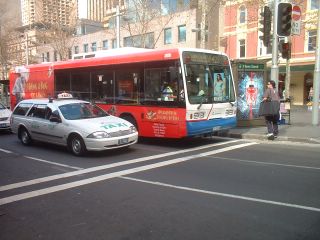
The public transport in SYDNEY offer many choices to the travelling public. Such as Trams, Monorail, Busses and Taxies. Couple with a good road system, efficient traffic management the city transportation is flowing smoothly even during peak hours. However we can observed in some part of the city there are traffic congestions during peak hours.  Posted by Picasa

Friday, September 30, 2005

SYDNEY light rapid system, The Tram. Posted by Picasa
SYDNEY MONORAIL SYSTEM Posted by Picasa

Thursday, September 08, 2005

Information is vital in public transportation

In public transportation one very important element in ensuring effective connectivity is information. My friend in France took this photo inside a bus, which have a digital display about the bus stop and location in a given route. Posted by Picasa

Monday, August 15, 2005

France Bus System: A Malaysian student experience

A friend recently went to further her studies in Toulouse, France. Being Malaysian whose main mode of transport is the automobile, the bus system in France is something she shared with me recently. Here is her e-mail (permission granted by the author)...

Just to brief a little bit on the bus system here.
I've taken pictures but just can't wait to explain everything because I am excited of the bus system as I understand better about the system now.

There are many main stations in between the bus routes. Each station is called 'ligne'. Between stations there are also several stops. There are phamplets available for each ligne to show the details of the ligne (arrival time of the bus at each ligne, the map of the ligne showing the stops between the ligne). I have taken the pictures of the pamplets for ligne 68 and ligne 10.

The time the bus passes each ligne is different between sunday through friday and saturday. Due to traffic in the town. Also depend on seasons. For example, during summer not many buses are available because most people are going for vacations.

The bus use a card system. We can buy a card of 7 euros for 10 trips. Each time you got on the bus, you will insert the card in the machine and the machine will stamp the date on the card. It does not matter how many times you change the stations or stops, as long as you are in the same direction AND you got on the next bus within 45 minutes that will be considered as 1 trip. For example in order for me to get to Capitol (downtown) I have to take the bus from my place to Lespinet Struxiano (ligne 68). Then, I have to take another bus that heads towards the next station that is Etats-Unis Fondeyre (ligne 10); Capitol is a stop between ligne 68 and ligne 10. If I can catch the bus on ligne 10 within 45 minutes, that will be considered as 1 trip.

On the bus, there is a map also, the same map you have on the pamplet. It shows the main stations and the stops. In the bus, in front; just above the passengers seats there is an electronic board (like a small billboard) informing the passengers of the next stop. So, we can always refer to the board and look at the map to ensure own location. There will also be an aural indication informing us of the next stop.

I took all the pictures; the ticket, the ticket machine, the small billboard, the interior of the bus. The only thing that I have not explore is their metro station. I heard we can use the same ticket for the metro and the rules are the same. I will let you know the system and take pictures of the metro soon.

Okey...I hope I have given you a clear information. I am not sure how much the information helps you. Is it something you already know or you haven't know. Just let me know what are other information that you need. I will send the pictures later. So, you might want to keep this email because it may helps you to understand better as soon as yo get the pictures.

Okey, I'm going for my lunch. today is Friday, so there no class in the evening. I'm taking my own sweet time to type the email...By the way, Etats-Unis is United States

Yours,

Ruhaida Abd Rashid


She promised to share a lot more experience of France's public transportation system. Once I've recieve her photos perhaps with her permission I could publish it on this blog.

Monday, June 06, 2005

Kyiv Ukraine

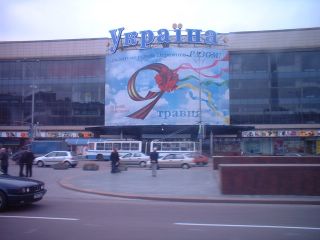
I was in Kyiv, Ukraine in mid of May 2005. The city was clean with lots of open spaces. Beautiful gardens. There are many forms of public transport. Many residents depended on public transportation as their means of commuting.I manage to snap a photo of their tram services (see below). Trams servive is popular among the resident, it is a major form of public transport in the city. However during peak period, I noticed there were also traffic jams...you just cannot win them all !!! Posted by Hello

Saturday, April 30, 2005

AUTOMOBILE AND MANKIND

The automobile is one of the wonder creation of modern man. Over the years it is perfected to be an efficient machine. Comfort. Safe...but it also creates problems to mankind...  Posted by Hello

Sunday, April 17, 2005

TRANSPORT OPTIONS FOR THE ELDERLY & DISABLED

Yesterday I was at MISC, a leading sea transportation company in Malaysia. I was lecturing to a class of executives preparing them for the Chartered Institute Of Logistics and Transportation professional qualification.

We discussed few issues. Among them are transport options for the elderly and the disabled in Malaysia.

Our conclusions are as below:

1. Their mobility is almost zero without begging others to help them

2. Policies to ensure a minimum level of mobility is also absent in Malaysia

3. The public is unaware or are just not interested in their plight

4. The are very few NGOs championing their rights

All of us if we survived long enough will reach the golden years. If we do not actively championed the rights of elderly and disabled to freely move themselves, then one day we will face the same situation.

Tuesday, March 15, 2005

SUBANG AIRPORT

Over the last few months, Subang Airport is one center of media attraction.

1. Air Asia, Malaysian own low cost carrier wanted the government to make Subang a hub for low cost flights.

2. MIGHT wanted the Government to make Subang the MRO hub. This call was first mooted in 1997.

Finally, the goverment decided to make Subang an MRO hub. And build a new low cost airlines terminal in KLIA Sepang.

Perhaps these decisions are more of a compromise after the bargaining and lobbying by both parties.

What about the travelling public? Are they in the circle when those decisions are made? Who represents them?

... only time will tell if we've made the right choices. The planners who are behind those decisions would know if their planning process has helped to increase the chances of the decision makers making the right decisions.